

The rules of the game have changed overnight. Imagine waking up to find your organic traffic slashed, not because you lost rankings, but because Google stopped sending users your way. This isn’t a dystopian prediction—it is the reality of Generative AI in search.
As the “click” becomes a luxury rather than a guarantee, how do you ensure your business doesn’t just survive, but thrives? The digital landscape is trembling, but for the prepared, it offers a massive opportunity to build undeniable authority.
The promise of Google’s AI Overviews (formerly known as SGE) is frictionless convenience: answering user queries directly on the results page. This paradigm shift raises a terrifying question for publishers relying on referral traffic: If the AI answers everything, why would anyone visit your site?
The Crisis of Informational Content
For industry veterans like Marta Romera, Head of SEO at Internet República, the diagnosis is harsh but necessary. “The click metric is losing relevance in this new ecosystem,” she warns.
Who is Internet República? They are a leading digital marketing agency known for pushing the boundaries of SEO and creative content in highly competitive markets. When their experts speak, the industry listens.
Content that is easily summarizable—the classic “what is X” or “how to do Y”—is now the domain of the machine. It is likely to be resolved entirely within the AI result block.
Romera suggests a critical pivot for your Generative AI SEO strategy: “If your model was based on capturing traffic by offering simple information, you have to ask yourself: Why would they click on my site after reading the AI summary?“
From Traditional Rankings to “Share of Voice”
As Large Language Models (LLMs) integrate deeper into the SERPs, the ten blue links are being displaced. We are seeing a complex cocktail of AI blocks, local packs, and multimedia carousels taking up prime real estate. Javier Sánchez, Head of Web Strategy at Digital Group, notes that while we have seen a 10% average drop in informational traffic, the “click” is far from dead—it is just evolving.
In this context, new KPIs are emerging to measure success beyond simple visits:
- Brand Mentions: How often is your brand cited by the AI?
- Contextual Authority: Being the source of truth that the AI uses to build its answer.
- Post-exposure Engagement: What the user does after seeing your brand in a generative result.
Eduard Corral (CTO at Buzz) defines this new approach as “Contextual Branding.” The goal is no longer just being ranked #1 statistically. The goal is to ensure your brand is the entity the AI associates with the solution.
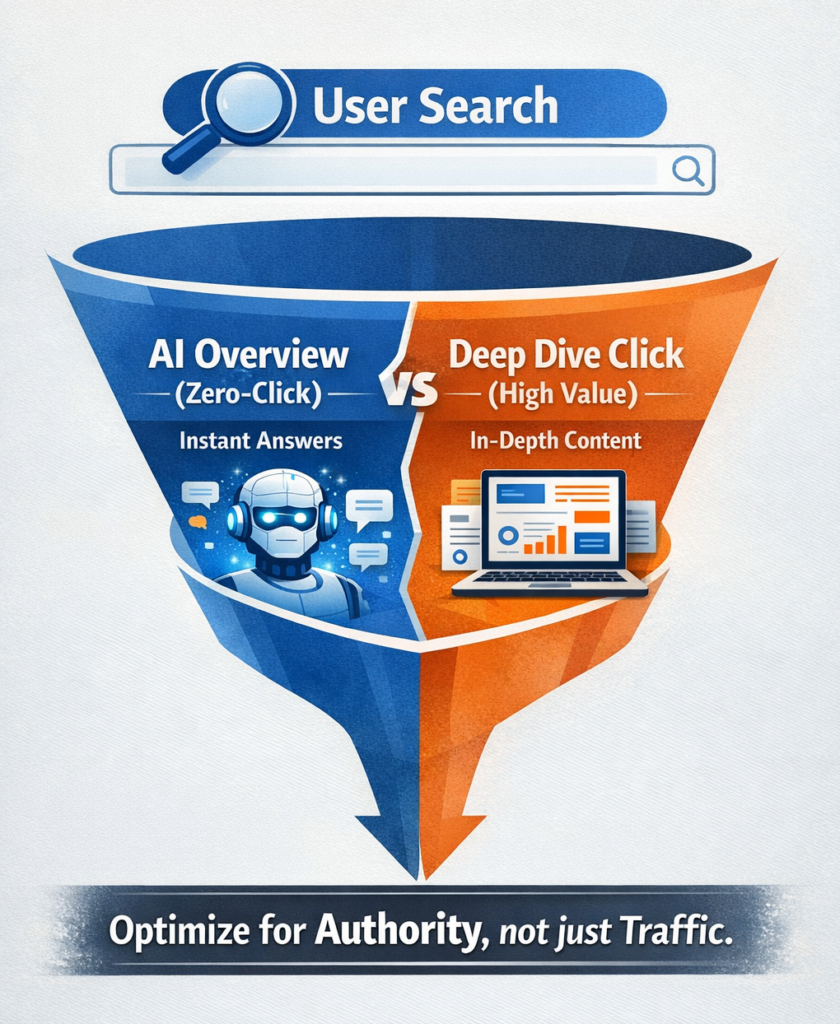
The Strategy: Offering What AI Can’t Emulate
If AI wins on speed and summarization, you must win on depth and humanity. The solution is to provide what a machine cannot fabricate: genuine experience and unique data. Romera suggests moving toward Inbound SEO by creating:
- Interactive tools and calculators.
- Exclusive multimedia content.
- In-depth analysis and original data that requires a visit to fully digest.
Rocío Lerma (Omnicom PR Group) adds that “SEO must evolve to be more ‘enveloping,’ combining presence, authority, and real utility.” This brings us back to the fundamentals of E-E-A-T (Experience, Expertise, Authoritativeness, and Trustworthiness).
Did you know? Google explicitly added “Experience” to the E-A-T acronym to highlight the value of first-hand usage. An AI can define a product, but it cannot tell you how it feels to use it. That is your competitive advantage.
SXO: The Evolution of the Search Experience
Is SEO becoming SXO (Search Experience Optimization)? Many experts agree. It is no longer about optimizing for a crawler, but for the entire user journey. Whether the user finds you on Google, interacts with an AI chatbot, or discovers you on a niche platform, the goal is to be a “citable and reliable source.”
As the industry moves toward “Search Everywhere Optimization,” adaptability is key. However, you must never lose sight of the fundamentals: high-quality content and a flawless technical foundation.
The era of “easy” traffic may be over, but the era of meaningful connections is just beginning. You don’t need to fear the AI shift if your technical SEO is solid and your content is undeniable. Focus on building your authority and let the right tools handle the grunt work.
Ready to future-proof your website? Ensure your technical foundation is flawless so you can focus on strategy. Download our all-in-one WordPress plugin today and make your SEO effortless.
Generative AI and the Future of SEO
How does Generative AI affect organic traffic for informational websites?
Generative AI often answers simple user queries directly on the search results page, which can significantly reduce referral traffic for websites relying on basic informational content. To maintain visibility, publishers must pivot towards offering unique data, in-depth analysis, and human experiences that artificial intelligence cannot easily summarize or replicate.
What strategies help businesses thrive alongside AI Overviews in search?
Businesses should focus on building undeniable authority and providing value that AI cannot emulate, such as interactive tools, exclusive multimedia, and original research. Emphasizing first-hand experience and expertise ensures your content remains a primary source for users who need more depth than a machine-generated summary can provide.
Why are traditional click metrics losing relevance in modern SEO?
With AI answering queries directly in the search results, users click through to websites less frequently for simple answers. Consequently, success is increasingly measured by new key performance indicators like brand mentions, contextual authority, and how often artificial intelligence cites a brand as a trusted source of truth.
What is the role of E-E-A-T in the era of Generative AI?
Search engines prioritize content reflecting actual usage and first-hand knowledge to counter automated content. While AI can define concepts, it cannot simulate genuine human interaction with a product or service. Demonstrating real-world expertise and trustworthiness becomes a critical competitive advantage for content creators seeking to outrank automated summaries.
How is SEO evolving into Search Experience Optimization (SXO)?
The focus is shifting from simply optimizing for search engine crawlers to enhancing the entire user journey across multiple touchpoints. Search Experience Optimization prioritizes being a reliable, citable source whether a user interacts with a search engine, an AI chatbot, or a niche platform, ensuring meaningful engagement beyond just the initial click.